
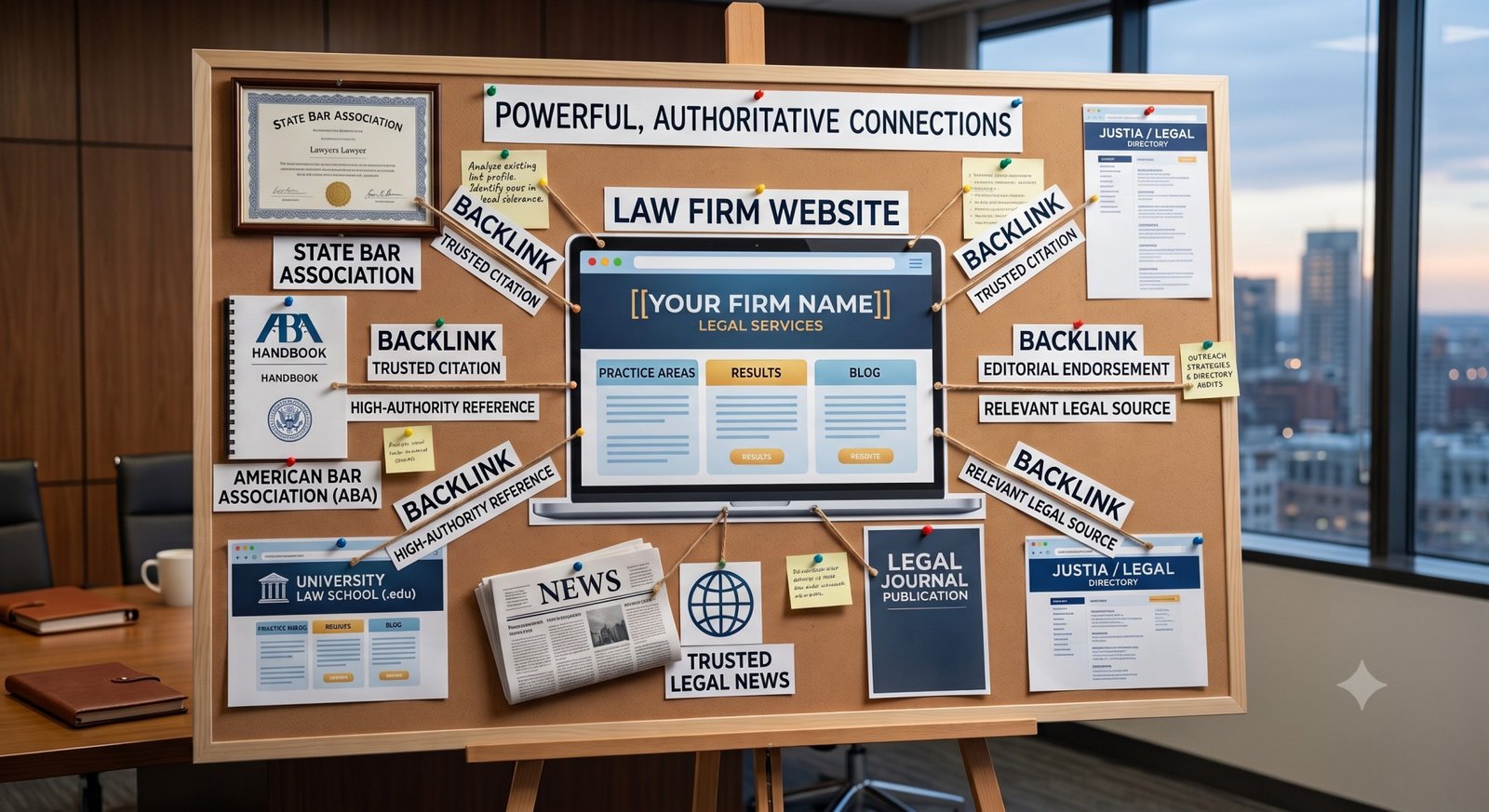


Legal is one of the most expensive and contested niches in search. Two firms can publish equally good content, fix every technical issue, and fully optimize their Google Business Profiles, and one will still outrank the other because its backlink profile is stronger. That is the short answer to why link building is important in this industry: when everything else is equal, links break the tie.
This guide covers what law firm link building actually involves, what separates valuable backlinks from the ones that create risk, and how to build backlinks that hold up over time.
What Is Law Firm Link Building?
Law firm link building is the practice of earning links from other websites back to your law firm’s website. Each link acts as a signal to search engines that another site considers your content or your practice worth referencing. If you want the underlying mechanics first, our guide to what a backlink is in SEO covers the fundamentals.
In legal marketing the term gets used loosely, so it helps to split it into two categories:
- Editorial backlinks. A journalist, association, university, or publication chose to include a link to your site because it added something for their readers. These carry the most SEO value.
- Placed links. Directory profiles, sponsorship listings, and paid contributions. Legitimate versions exist and most firms need some of them, but this is also where nearly every penalty in legal SEO originates.
Telling those apart is most of the skill involved.
Why Backlinks Still Matter for Law Firm SEO
Google’s ranking systems have changed substantially, and every year someone announces that links are finished. They aren’t. Backlinks remain one of the clearest signals search engines have for judging whether a site deserves visibility, and there are three reasons they carry extra weight for law firms.
Backlinks signal trust in a YMYL niche
Google classifies legal content as YMYL, short for “Your Money or Your Life,” because it can affect someone’s finances, freedom, family, or safety. Pages in this category are held to a higher standard for demonstrable expertise and reputation. Off-site signals are the main way that reputation becomes legible to a search engine. When a county bar association, a law school, or a local news outlet links to your firm, that is external corroboration Google can measure. This matters more for law firms because legal queries carry consequences that a product review does not.
The economics force everyone into organic
Legal keywords are among the most expensive in paid search anywhere. A single personal injury or mass tort click can cost more than a month of hosting. When acquisition is that expensive, every competitor in the market invests heavily in organic, which means the link gap between position three and position eight is often the entire difference in caseload.
Links support local SEO as well as organic
Law firm searches are overwhelmingly local. Backlinks do double duty here: they build classic domain-level authority and contribute to the prominence signals that influence local pack placement. A link from a city bar directory or a regional paper improves both surfaces at once. A high-DR link from an unrelated overseas site improves neither.
What Makes High-Quality Law Firm Backlinks
Most firms evaluate link opportunities on a single metric, usually domain authority or Domain Rating. That one habit wastes more legal SEO budget than anything else. Use these criteria instead, roughly in priority order.
Relevance to the legal industry
Does the linking page have any plausible reason to reference an attorney? A legal publication, a court reporting service, an insurance blog, a community organization, or a local news site all make contextual sense. A DR 68 cryptocurrency review site does not, whatever the metrics say. Backlinks from relevant sources consistently outperform stronger backlinks from unrelated ones.
Geographic relevance
The most frequently ignored criterion. A Boston criminal defense firm gains more from the Boston Globe, a Suffolk County bar listing, or a Massachusetts legal aid resource page than from a national domain with ten times the authority. Backlinks from local sources answer the question Google is actually trying to resolve: who serves this metro area?
Practice area alignment
A link earned through commentary on a construction accident supports a personal injury practice. The same link does almost nothing for the firm’s employment law or immigration departments. If your firm runs multiple practice areas, map link acquisition to specific practice area pages rather than funneling everything into the homepage.
Real traffic and indexation
Check that the linking page is indexed and that the domain receives organic traffic. A large share of the “high-authority backlinks” inventory sold to law firms sits on domains that have been deindexed, have collapsed in traffic, or exist solely to sell placements. The organic traffic trend is a better indicator of legitimacy than any authority score.
Editorial context and placement
A link inside the body of an article, surrounded by relevant text, carries far more SEO value than links buried in a footer, a sidebar, or an author bio beneath 400 words of filler. Where the link sits on the page matters as much as which page it sits on.
The outbound neighborhood
Look at who else the domain links to. If its outbound profile mixes casinos, offshore pharmacies, and unrelated commercial sites, that is a footprint, and your law firm’s website will share it.
Link Building for Law Firms: 12 Ways to Earn Backlinks
Ordered loosely from foundational to advanced.
1. Legal directories
Directory backlinks are the baseline, and not all legal directories are equal:
- Tier one: Justia, Avvo, FindLaw, Lawyers.com, Martindale-Hubbell, Nolo, Super Lawyers. Established, editorially maintained, genuinely used by consumers, and expected by Google as part of a normal legal profile.
- Tier two: State and regional legal directories, plus practice-specific listings for immigration, IP, or family law.
- Tier three: Unscreened general business directories. Marginal value for name, address, and phone consistency. Complete them once and move on.
Legal directories are table stakes, not a strategy. A firm whose entire link profile is directory listings will plateau quickly.
2. Bar association profiles
State, county, and city bars, plus specialty associations: trial lawyers’ associations, criminal defense bars, women’s bar associations, and affinity bars. Most offer member directory profiles that include a link. These are among the most relevant backlinks available to any firm: topically and geographically ideal, and effectively impossible to fabricate. Also pursue section and committee pages, CLE speaker listings, and conference programs.
3. Law schools and alumni pages
Every attorney at the firm attended one of the law schools, and most maintain alumni spotlight pages, mentor directories, moot court judging rosters, adjunct faculty listings, and career services employer pages. Authoritative backlinks, deeply relevant, and usually free. Also badly underused, because someone has to actually email the alumni office.
4. Local citations and civic organizations
Chamber of commerce membership, Rotary and Lions clubs, business improvement districts, downtown associations, economic development groups. Individually modest, collectively they build the geographic cluster that local SEO depends on.
5. Sponsorships
Youth sports, 5K races, charity galas, school programs, food banks, legal aid clinics. Most sponsors get a listing page with a link. Two cautions: keep spend proportionate to genuine community involvement rather than treating it as link buying, and confirm the sponsor page is indexed before committing.
6. Digital PR and original data
The highest-ceiling tactic available to a law firm. You can attract backlinks by offering journalists something they can’t get elsewhere:
- Analysis of public court records or crash data by county
- A records request turned into a report
- Original surveys of a relevant population
- Seasonal safety analyses: DUI arrests over holidays, e-scooter injuries, workplace incidents by industry
- Rankings of the most dangerous intersections or corridors in your metro
One well-executed study can earn backlinks from dozens of local news outlets, which are precisely the high-authority domains no vendor can sell you.
7. Expert commentary
Reporters need attorneys to explain legal developments. Journalist request services, direct relationships with local newsrooms, and a well-timed pitch when a major case breaks all produce links from mainstream media that cannot be bought. What it requires is speed and real expertise, not clever outreach copy.
8. Guest contributions worth publishing
Not the guest post marketplace kind. Reputable legal publications, state bar journals, practice-specific trade press, business journals, and vertical media serving your clients: a construction trade magazine for a construction defect practice, or an HR publication for an employment law practice. These require genuine writing from a real attorney, which is exactly why they still work. That is the difference between a marketplace placement and genuine guest posting on publications with editorial standards.
9. Podcasts and interviews
Show notes almost always include a link to the guest’s website. Legal podcasts, local business shows, and industry programs relevant to your client base are all accessible to a partner willing to spend forty minutes talking.
10. Awards and recognition
Best Lawyers, Chambers, Rising Stars, regional business journal awards, “40 under 40” lists. Legitimate awards produce a profile page with a link. Avoid the pay-to-play award mills. They leave a visible pattern, and several state bars restrict how such awards may be advertised.
11. Referral partners and co-counsel
Your firm already has professional relationships: co-counsel, referral partners in adjacent practice areas, expert witnesses, medical providers, accountants, mediators. Many maintain a resources page and will include a link. See the compliance section below, because several jurisdictions regulate anything resembling payment for a referral.
12. Legal aid and resource pages
Nonprofits, tenant unions, domestic violence shelters, immigrant support organizations, veterans’ groups, and government agencies often publish attorney referral pages. Genuine pro bono work or clinic volunteering is usually the route in. These pages are trusted precisely because they cannot be purchased.
Link Building for Lawyers by Practice Area
| Practice area | Where the backlinks come from |
| Personal injury | Digital PR, crash and safety data, local news, trial lawyer associations, community sponsorships |
| Criminal defense | Local news commentary, defense bar associations, reentry and advocacy nonprofits, law school clinics |
| Family law | Parenting and mental health resources, domestic violence organizations, mediation and financial planning publications |
| Immigration | Cultural and community organizations, employer HR resources, university international student offices, multilingual media |
| Estate planning | Financial adviser and accountant partnerships, senior services groups, retirement publications, elder care resources |
| Employment law | HR trade publications, worker advocacy groups, business journals, industry associations |
| Intellectual property | Startup accelerators, university tech transfer offices, trade press, inventor communities |
| Mass tort | Health publications, consumer advocacy groups, national news, condition-specific patient organizations |
A single link building campaign spread across five practice areas dilutes all five. Point each set of links at the page it is supposed to help rank.
How to Build Local Backlinks for Your Law Firm Website
For multi-location firms, links have to be built per market rather than per brand. A firm with offices in Phoenix, Tucson, and Mesa needs distinct signals pointing at each location page: the local chamber, the county bar, the city paper, the neighborhood association, the regional sponsorship.
This work is slow and unglamorous, and it is also why national vendors rarely move local rankings. Nobody builds a credible Tucson signal cluster from a spreadsheet in another state.
Building a Backlink Strategy That Improves Ranking in Search Results
A backlink strategy is a sequence, not a monthly quantity. This is the order that works:
- Audit the existing link profile. Map what you have, flag toxic placements, and measure the composition gap against firms currently ranking.
- Complete the foundation. Bar profiles, tier-one legal directories, alumni pages, chambers, citation consistency. Cheap, fast, and half-finished at most firms.
- Build assets worth linking to. Original data, genuinely useful guides, calculators, local resource pages. Manual outreach without an asset behind it is just asking for a favor.
- Invest in relationships. Journalists, association committees, podcast circuits, referral partners. These compound; transactional link acquisition does not.
- Run campaigns. Digital PR pushes, expert commentary, contributed articles. Track pitches and reply rates, not just placements.
- Monitor and prune. Watch for lost links, negative SEO, and degraded placements. Reclaim unlinked brand mentions, usually the easiest backlinks available to any established firm.
How Many Backlinks Does a Firm Website Need?
There is no universal number, and any provider quoting one is selling volume. Derive the target from a gap analysis instead:
- Identify the three to five firms actually ranking for your target terms in your city.
- Pull referring domain counts for the specific ranking pages, not just their root domains.
- Note the composition: how many are news outlets, bar associations, directories, sponsorships.
- Measure velocity: how many new referring domains they add per month.
- Plan to close the composition gap at a rate you can sustain indefinitely.
A competitive personal injury market in a major metro may require ten to twenty quality backlinks from new referring domains every month for a year before rankings move decisively. A rural estate planning practice might compete on a fraction of that. The market sets the number.
Link Building Tactics That Damage Legal SEO
Legal is among the most heavily policed verticals in search. These are the recurring problems.
Private blog networks. Interlinked sites built to sell links, identifiable by shared hosting, registrant patterns, template similarity, and outbound profiles. Constantly repackaged and resold to law firms as premium placements.
Guest post marketplaces. Sites that accept any topic from any buyer. The tell is a legal article sitting between a crypto review and a supplement listicle.
Spun legal content networks. Dozens of thin legal blogs publishing near-duplicate articles. Especially common in this niche.
The scholarship scheme. Creating a token scholarship purely to request links from university financial aid pages. Universities caught on years ago; most now remove or nofollow these. A spent tactic and a reputational liability.
Reciprocal networks between firms. A cluster of unrelated firms in different cities all linking to each other is a recognizable pattern.
Buying backlinks by volume. “500 legal backlinks for $199” is a description of the problem, not a service.
On paid links specifically: Google’s guidelines require that any link exchanged for money be qualified with rel=”sponsored” or rel=”nofollow”. Directory memberships and genuine sponsorships sit in practical gray territory. A paid link from a site that openly sells placements to anyone does not.
The asymmetry is what should decide this. A manual action against a law firm’s website can cost six figures in lost case value while the firm spends months on reconsideration. No cheap link is worth that exposure.
Bar Compliance and Attorney Advertising Rules
This is where legal link building diverges from every other niche, and it is routinely missed by agencies without legal experience.
Attorney advertising is regulated. Most US jurisdictions build on ABA Model Rules 7.1 through 7.3, but every state adapts them, and Florida, Texas, New York, and New Jersey impose additional requirements. The points that intersect with link building:
- Misleading claims. Directory profiles and author bios describing a firm as “the best” or implying outcomes can breach rules against false or misleading communications.
- Specialization language. Many jurisdictions restrict “specialist,” “specializes in,” and “expert” unless the attorney holds a recognized certification. This wording appears constantly in boilerplate directory copy.
- Testimonials. Rules differ widely on whether client testimonials are permitted and what disclaimers must accompany them.
- Paying for recommendations. Most rules distinguish paying for advertising (generally allowed) from paying for a referral or recommendation (generally restricted). A sponsored “recommended attorney” placement can land on the wrong side of that line.
- Required disclaimers. Some states mandate specific labeling on advertising communications, which can extend to third-party profiles.
Practically: have whoever handles compliance at the firm review the copy used in directory profiles, author bios, and sponsored placements before it publishes, and keep a record of what was published where.
None of this is legal advice and the rules change. Your firm’s compliance counsel or your state bar’s ethics hotline is the authority on your specific obligations.
Anchor Text and a Natural Link Profile
A healthy legal link profile skews heavily toward brand. A workable distribution:
- Branded. Firm name, attorney name, bare domain. The majority of links.
- Naked URLs and generic. “Click here,” “this analysis,” the URL itself. A substantial share.
- Partial match. “Personal injury claims in Ohio,” “employment law guidance.” A modest portion.
- Exact match commercial. “Cleveland car accident lawyer.” Used sparingly, and almost never on anything placed or paid.
Two rules: leave earned links alone even when the anchor is imperfect, and never make exact-match commercial anchors the default request in outreach. Repeating the same commercial anchor across dozens of placements is a pattern, not a strategy.
Measuring SEO Performance
Leading indicators, visible in weeks: new referring domains, quality mix, outreach reply rate, unlinked mentions reclaimed.
Lagging indicators, visible in months: rankings on target practice area and location pages, organic sessions to those pages, local pack visibility, calls and form fills, and finally signed cases and case value by channel.
The number that matters is signed cases from organic search. Referring domain count is an input and should never be reported as an outcome.
Choosing Law Firm Link Building Services
If you are evaluating link building services or broader legal SEO services, the questions that separate the credible from the rest:
- Can they show the actual domains they’ve earned links on for other firms, not just aggregate metrics?
- Do they build local backlinks in your specific market, or run one national list?
- What is their process for earning links, and does it require anything from your attorneys? (If the answer is “nothing,” they are buying.)
- Do they map link acquisition to practice area and location pages?
- Who reviews profile and bio copy for bar compliance?
- How do they handle lost links and pruning?
- What do they report, and does it connect to signed cases?
Common Mistakes in Law Firm Link Building
- Pointing every link at the homepage instead of practice area and location pages
- Buying on domain authority alone
- Ignoring link attrition, which is steady and real
- Leaving unlinked brand mentions uncollected
- Reusing identical anchor text across placements
- Letting an agency publish non-compliant profile copy
- Expecting results in eight weeks
- Treating link building as separate from content, technical SEO, and local SEO
Examples of Quality Law Firm Backlinks
- Attorney at Work (attorneyatwork.com) — practice management and legal marketing publication read by attorneys and firm administrators.
- National Law Review (natlawreview.com) — high-authority legal news and analysis site publishing contributed articles from credentialed legal professionals.
- Legal Reader (legalreader.com) — legal news and commentary site that publishes contributed pieces from firms and attorneys.
- Lawyer Monthly (lawyer-monthly.com) — legal industry magazine covering firm news, awards, and expert commentary.
- Leaders in Law (leaders-in-law.com) — global legal expert network with member profiles and an annual awards publication.
- USAttorneys.com (usattorneys.com) — national attorney directory organized by practice area and location.
Frequently Asked Questions
- How long does law firm link building take to work? Foundational work can influence rankings within one to three months. Competitive practice areas in major metros usually need six to twelve months of consistent link acquisition before positions move decisively.
- Do backlinks still help law firm SEO? Yes. Backlinks remain a key ranking factor, and their weight is if anything higher in YMYL niches like legal, where Google leans harder on external signals of reputation.
- Are paid links against Google’s guidelines? Links exchanged for money that pass ranking signals violate Google’s spam policies unless marked sponsored or nofollow. Directory memberships and legitimate sponsorships are treated pragmatically; PBNs and guest post marketplaces are not.
- Do nofollow backlinks have any value? Yes, for referral traffic, brand visibility, and profile diversity. A nofollowed mention in a major newspaper is worth more to a firm than a followed link from a content farm.
- Can a law firm build links itself? The foundation, yes. Bar profiles, alumni pages, chambers, and citation cleanup need follow-through rather than expertise. Digital PR and journalist relationships require sustained time most practicing attorneys don’t have.
- What about backlinks from other law firms? Genuine co-counsel and referral relationships are fine. Organized reciprocal networks are detectable, and paying for a referral may breach professional conduct rules.
- Should backlinks point to the homepage or interior pages? Interior pages, mostly. Practice area and location pages are the ones that need to rank. Homepage-only link building is one of the clearest markers of an unsophisticated campaign.
- How do you spot a toxic backlink? Deindexed or traffic-less domains, irrelevant outbound profiles, template-identical sister sites, open “write for us” pages with no editorial standards, and any domain that sells placements publicly.
- Do backlinks affect Google Business Profile rankings? Indirectly. Local rankings weigh prominence, and authoritative local backlinks contribute to it, which is why geographic relevance beats raw domain authority for local legal search.
- What is the single highest-return tactic? Original data local journalists want to cover. Nothing else reliably earns backlinks from the high-authority local domains competitors cannot buy.